“Pick ’em up and lay ’em down”
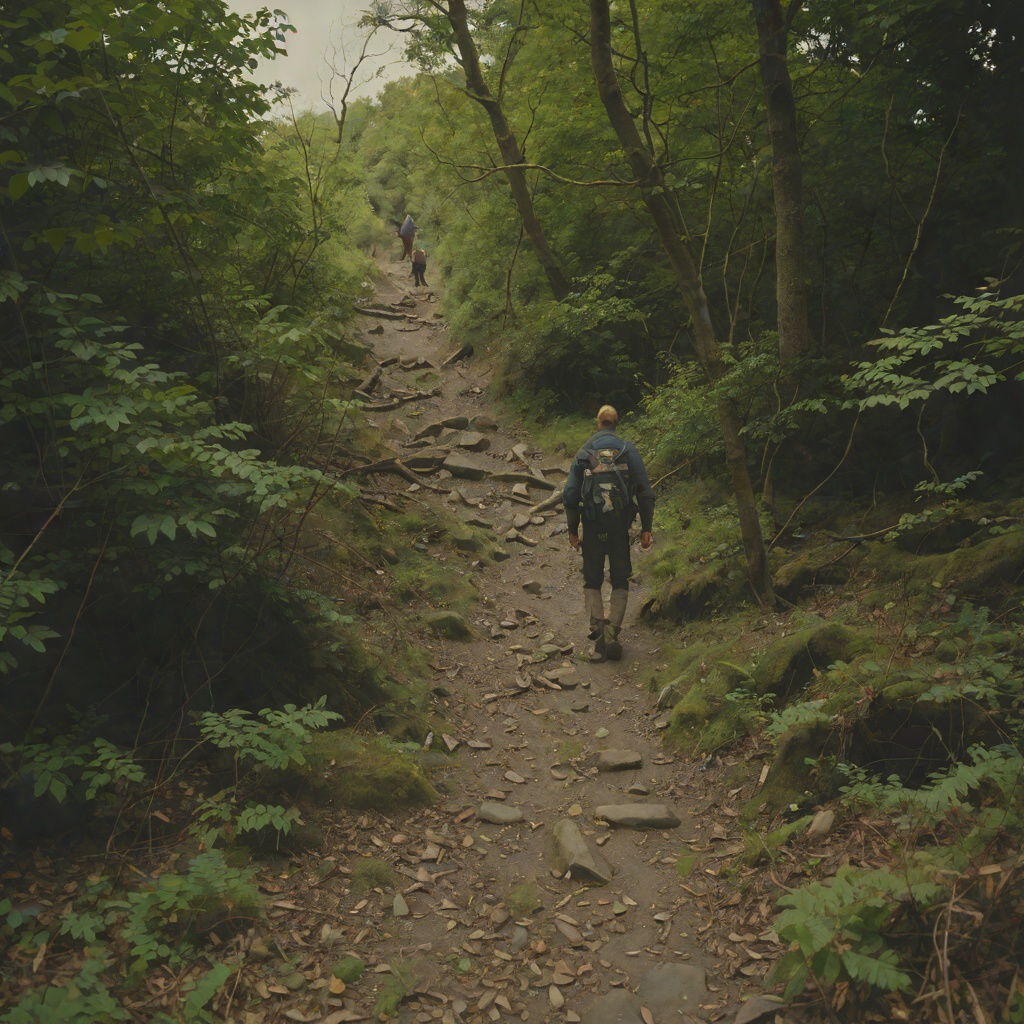
The Long Walk“Pick ’em up and lay ’em down” is both a practical instruction and a governing verbal rhythm of The Long Walk. It names the smallest possible unit of survival—lifting one foot and setting it down again—while exposing how the Event strips the Walkers of biography, choice, and future until continued motion is all that remains.
Definition and First Use
The expression first appears as the language of bodily concentration. When Gary Barkovitch tells Ray Garraty that a Walker must focus on calmness, pace himself, and have a Plan, Hank Olson rejects the abstraction. His answer, “All I'm focusing on is pickin' 'em up and layin' 'em down,” turns walking into a narrowly material task. Olson does not answer Barkovitch with a competing theory of the Long Walk; he answers with feet. The phrase therefore establishes a contrast between Barkovitch’s attempt to impose a strategy on the Event and Olson’s immediate discipline of continuing one step at a time.
The wording also carries a deliberate reduction in scale. The State has organized the Long Walk around distance, speed, warnings, soldiers, and elimination, but the Walker experiences those structures through muscles and feet. The expression pushes every larger question out of the mind. It does not promise victory, safety, or even meaning. It offers only an action that can be performed again.
Repetition as Survival Practice
Ray Garraty adopts the same method when he is still physically strong. On an uphill stretch, he concentrates on picking the Walkers up and putting them down and feels strong as a result. In that early context, the phrase describes controlled effort rather than desperation: attention to the immediate movement helps him preserve a sense of bodily command. The repeated motion is not yet merely a sign of collapse; it is a technique through which he organizes his endurance.
Hank Olson embodies that technique even more plainly. After other Walkers have begun to fall, Olson says nothing and simply keeps picking them up and laying them down. His silence gives the phrase a second force. Spoken language may interpret the Long Walk, but Olson’s repeated movement answers it directly. The phrase becomes an action without commentary, a compact expression of discipline maintained in the presence of death.
That discipline exists inside an increasingly brutal numerical order. The Walkers have covered roughly eighty miles when Ray Garraty and Peter McVries recognize that they are a quarter of the way home, yet twenty-seven boys are already gone. Later, after ninety-nine miles, only thirty-six have been eliminated, a fact Garraty receives with hungry, hostile relief because the progress of the survivors depends on the disappearance of others. The phrase’s simplicity thus conceals a changing moral landscape: every step sustains the individual Walker while the collective field contracts around him.
Against Fear, Memory, and the Body
The expression becomes most urgent when Garraty’s physical and mental control begin to fail. On a punishing hill, warnings crack out around him, his muscles seem to soften and tremble, and he forces himself to match Olson’s pace. He tries to make the immediate rhythm protect him from thoughts of Stebbins, McVries, Jan, his father, and Freaky D'Allessio, whose head was destroyed beside U.S. 1. In this setting, “pick ’em up and lay ’em down” is not cheerful encouragement. It is a barrier erected against memory, fear, and the knowledge that the body may stop obeying.
Peter McVries gives the principle its clearest formulation when Garraty admits that Hank Olson, Scramm, and Davidson have died and that death now feels close behind him. McVries tells him to think about Jan, his mother, or his cat—or to think about nothing—and to keep walking down the road. His advice joins emotional attachment to mental blankness: familiar relationships can steady Garraty, but thought itself can also become dangerous if it interrupts the required pace.
The expression therefore has a paradoxical function. It preserves agency by telling the Walker what to do, yet it narrows agency to an involuntary-seeming repetition. The Long Walk demands that the boys remain active enough to move but passive enough not to challenge its terms. The phrase sounds like self-command, while its surrounding conditions reveal a system that has made self-command the Walker’s last available defense.
Public Chant and Institutional Violence
Near the end, McVries transforms the instruction into a chant: “Pick 'em up, put 'em down, shut your mouth.” The altered second verb does not change the principle; it sharpens its coercive edge. The phrase is now paired with silence. A Walker must move, must not speak, and must continue while his shoulders resemble a broken bow. The bodily rhythm has become a public-facing formula for endurance at the very moment when endurance is visibly destroying the person who performs it.
The chant’s force is intensified by the machinery surrounding the Walkers. At the beginning, an old blue Ford enters a guarded parking lot, a guard takes Ray’s blue plastic identification card, and a computer terminal consumes it before displaying his registered name and address. The identity check presents the Event as administrative procedure before the walking begins. Once the Major’s hand falls and he says, “Luck to all,” the boys cross the marker in orderly motion, with the sound of their feet becoming unnaturally loud. The phrase later supplies the verbal counterpart to that sound: a human voice reduced to the same repeated operation as the marching bodies.
The Event’s official violence turns each failure of the rhythm into a statistic. Ewing falls below speed for the last time among other boys; soldiers push the others aside, drag him to the shoulder, and shoot him after pinning his arms. The narration immediately registers that two boys are gone and that the odds have shifted infinitesimally in favor of those remaining. The expression’s insistence on the next step consequently exists beside a counting system that converts death into altered odds.
The same contradiction appears when Olson attacks a halftrack. He climbs toward the soldiers, seizes a rifle barrel, and continues after being shot through the belly, even taking hold of the gun that has fired at him. His action temporarily breaks the expected relation between warning, bodily failure, and elimination, but it does not abolish the system. The State’s weapons remain present, and the spectacle of resistance is absorbed into the Event’s continuing sequence of bodies and numbers. “Pick ’em up and lay ’em down” is thus both a survival rule and the sound of compliance demanded by an armed authority.
Final Significance
By the later stages, the expression has lost any stable promise of control. Garraty imagines himself as a name and number to be entered in official records, eliminated at a specified mile, followed by a brief human-interest story calling him Maine’s Own. His fear is not only death but the conversion of death into a record. The repeated instruction counters that conversion with a minimal bodily fact: before a Walker becomes a number, he is still moving. Yet the phrase also assists the process, because it teaches him to ignore the relationships and meanings that make him more than a measurable participant.
The expression’s recurrence traces the Long Walk’s movement from concentration to exhaustion and finally to near-erasure. It begins as Olson’s answer to a proposed Plan, becomes Garraty’s method for crossing difficult ground, returns as McVries’s emergency counsel, and ends as a chant spoken by a man whose body is nearly spent. Its grammar is sequential rather than progressive: one foot, then the other, with no secure arrival contained in the words themselves.
That is why the expression remains more than a slogan. It is the Event’s compressed philosophy of survival and its indictment at once. The boys are told to reduce life to motion because motion is the only condition under which they remain alive; the same reduction makes them legible to the State as speed, warnings, rankings, and casualties. In “Pick ’em up and lay ’em down,” endurance sounds like freedom, but the repetition reveals how completely the Long Walk has captured the body.